Premise
Almost five thousand years ago, starting from the Mediterranean area, a simple geometric design that was given the name “labyrinth” began to spread throughout the world, allowing each cultural context in which it was found to change its shape, size, meaning and function. Thanks to its ductility, the labyrinth has become a universal symbol, or rather, a symbolic complex since the distant times of its appearance. What is the labyrinth? First of all, it is a geometric design, more or less complex, made up of various lines and lanes arranged in a spiral or a square that trace a path towards the center. The entrance coincides with the exit, thus signaling, from the beginning, its constitutional symbolic ambivalence or the proximity, overlap or even coincidence between opposite meanings. The impression created is that of an inextricable tangle of meanders, in which it is easy to get lost, which is why we often use the metaphor of the labyrinth to indicate complicated situations and problems, even if, as we will see, the disorder is almost always only apparent. In ancient times, the labyrinth symbolized primordial chaos and the effort to impose order on it. Its spiral design recalls a coiled snake, the entrails, but also the meanders of the brain.
Since it has always been invested with magical, propitiatory and protective powers, there is no cosmogony or founding myth in which it is not present. At the same time, the labyrinth has been associated with the danger of getting lost, of disorientation; whoever enters it risks being trapped. Courage and intelligence are needed to travel that winding path from the beginning to the end. The myth of the Minotaur already tells us that Theseus managed to go back, after having defeated the monster, only thanks to Ariadne’s thread, a ball of yarn to unwind on the way out to find the exit. On closer inspection, however, there was no need for that cunning, since the Cretan labyrinth is monocursal: it consists of a single path that knows neither forks nor shortcuts and necessarily leads to the center and from there out again, unless you exit by flying as Daedalus did to escape the labyrinthine palace of Knossos of which he himself was the architect. The thread was therefore not a means of conduction, but rather a means of conduct: it indicates method, attention and continuity. The labyrinth itself resembles a thread arranged like a ball of yarn, as if to say that nothing is simple and linear. It is the mental thread that uninterruptedly holds together, that creates bonds and traces the boundaries of our existential space. Arianna therefore expresses our rational will: only by adopting and remaining faithful to a method can one reach the center, win the fight with the monster, the demon, the nightmare, the terror that inhabits it and return safe, but transformed and initiated into a different life.
The Renaissance, an era that interests us particularly because it determines the landscape context where the performance will take place, marks a drastic change in the symbolism of the labyrinth that sees the exclusively religious contents fade away. Renaissance man, strong in his own subjectivity, emancipates himself from the vision of the sinful man obsessed with saving his soul. He enters the labyrinth no longer in search of salvation, but to know himself. His becomes an exploratory journey of his own individual experience. In this new meaning, the labyrinth leaves sacred spaces and arrives in profane ones, leaves churches and monasteries and enters palaces and gardens as an ornament and playful pastime. Created with evergreen hedges, sheltered from the changing seasons and in the illusion of being able to suspend time, it thus reflects man’s attempt to tame chaos, time and nature.
What
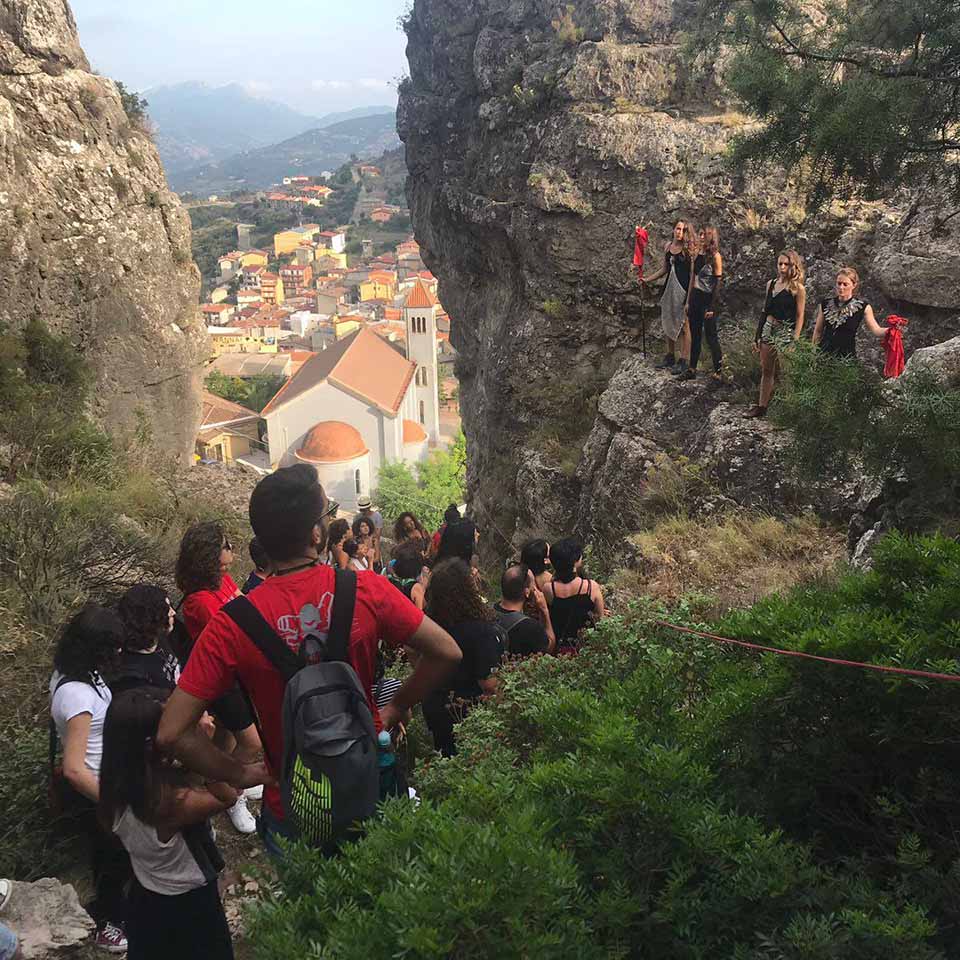
Arianna and Teseo have a special alchemy: their magic words are listening, intimacy, relationship. A traveling performance that immerses and feeds on nature and landscape. A research that is (re)born every time thanks to the encounter with different artists, places, territories, spectators and that from time to time for this takes on a new form. After the previous stages at the latest editions of Il Giardino delle Esperidi Festival, dedicated to the myth of the Hesperides and Fire, and following the Finnish one created for Hanko Festival and in the past edition of the Festival del Mare di Camogli on the figure of the Siren, Pleiadi Art Productions presents a new stage of this artistic research. Therefore Daedalus built for himself and his son two pairs of wings woven of light feathers; he attached them with wax to Icarus’ shoulders and arms and fixed them to his own back, then he waited for the servants to sleep and, turning to his son, said: “Follow me, Icarus”… The flight of Daedalus and Icarus towards a sought-after freedom from the labyrinth starts from afar. Following their story means retracing the footsteps of Theseus and Ariadne, following the thread, reaching the centre, the Minotaur, and only then being able to exit. The labyrinth, symbol of primordial chaos, is similar to a coiled snake, to viscera, brain, to that same red ball of yarn that Ariadne, in fact the queen of that apparent tangle, offers Theseus – and with him to the spectators – the possibility of following the necessary path, meeting and facing the monster without running the risk of getting lost and, finally, finding oneself again. For a fuller awareness of oneself, one must enter it, that labyrinth which is also ours, touch its heart and exit. A physical, mental and emotional journey, strongly intimate and sensorial, which feeds on the City of Camogli and its Sea which will be the natural setting.
The project is realized with the support of Campsirago Residenza, NEXT – Regione Lombardia, Fondazione Cariplo. Project partners, alongside Pleiadi Art Productions, are ScarlattineTeatro, Cada Die Teatro, GAL Ogliastra, Fattoria Vittadini.